
Off-grid Nature Escape | Breathtaking Views | Trout Fishing | Eco-cottages

Two Dam Sustainable
Farm Sustainability
What puts the "sustainable" in Two Dam Sustainable?
Two Dam Sustainable is run my Marco & Vivian - two passionate sustainability enthusiasts who come from a background of conservation. Before settling down on the farm to have their children, Erik and Olivia, they led an exciting life working together running a luxury boutique safari lodge. They bring this experience alongside a love for fishing and birding, and a dedicated commitment to working with nature. This is what makes Two Dam Sustainable, a farm that doesn't just talk sustainability but truly lives it.


Conservation & Biodiversity
-
The farm is in a biological hotspot, as a combination of three vegetation types meet here, namely Fynbos, Renosterveld and Succulent Karoo.
-
We are also home to a number of wild life species
-
We are founding members of the Pietersfontein Conservancy, the 99th Conservancy registered in the Western Cape by CapeNature.
-
Founded in late 2021, our conservancy spans a vast area of 10461 hectares,
-
The conservancy is a community-driven initiative that brings together 35 farm properties and 19 landowners who share a common goal: to preserve and sustainably manage the rich natural resources within our region. Through voluntary cooperation and a shared commitment to conservation, our members contribute to the protection of wildlife populations and the enhancement of the environment's overall conservation status.
-
The conservancy was honored as the runner up for the 2022 Cape Fox Conservation Driver Award in recognition of the progressive conservation achievements that our newly fledged conservancy had reached
Leopards on the Farm and the Klein Karoo
-
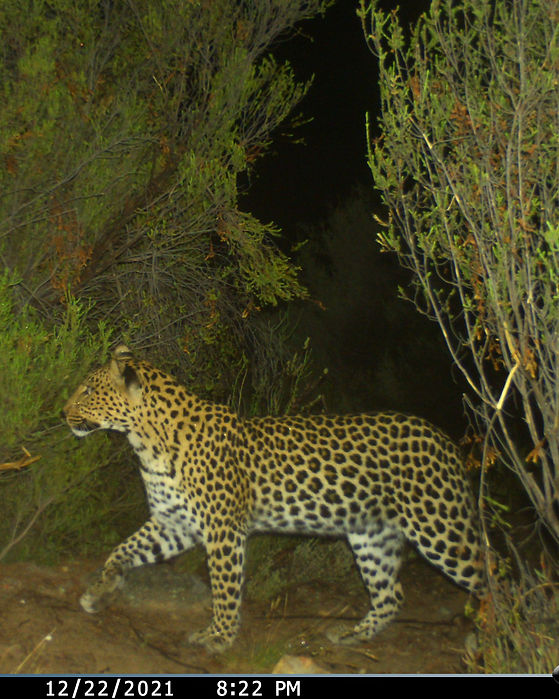
We have been collecting data on leopards here since 2014 with the hope to gain a better understanding of their presence and movements on our farm and beyond.
-
Comparatively little is known about this elusive apex predator species, which still roams over vast areas of the Western Cape, including the Langeberg Mountains near Montagu.
-
We have several cameras set up around the farm which have managed to capture these beautiful animals even though they are rarely - if ever - seen by those living on or visiting the farm.
-
By sharing these records with our community and creating awareness we intend to contribute meaningfully to their conservation.
-
Recently we became associated with the Cape Leopard Trust and have been sharing records of leopard camera trap and spoor sightings on their online data portal. These records will aid with the continuous monitoring and scientific research projects conducted on the species.
-
You too can become involved by photographing leopard spoor or scat if you encounter these on our numerous hiking trails and sending them on to us or visiting app.capeleopard.org.za to submit the data yourself.”
Eco-friendly Building Materials
-
We have an Alien vegetation clearing programme where exotic invasive species, including sisal, black wattle, prickly pear, other exotic cacti species and large eucalyptus trees as well as saplings in the main stream have been systematically eliminated to encourage growth of indigenous flora and reduce water consumption.
-
The alien clearing project supplies the farm with sustainable building material and fire wood eliminating the need to look elsewhere for indigenous wood or importing wood altogether. To date our chicken coop, sheep kraal, shade net support structure of the fish farm, pig sty, goat pen, dry composting toilet enclosure and staircase railings have all been built with locally harvested eucalyptus poles.
-
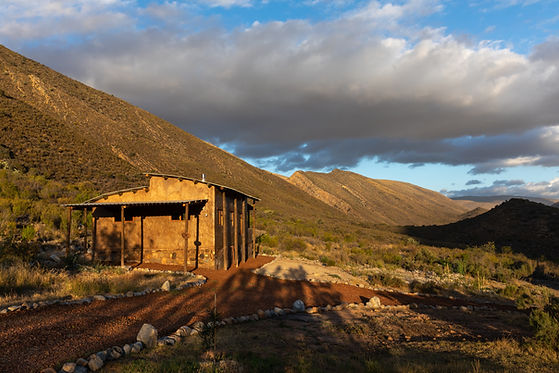
Our self-catering accommodation is made almost entirely out of mudbricks with a natural stone stemwall. Special care was taken to avoid/reduce more conventional building materials that have a larger environmental impact.
-
A large component of the building materials come from the farm itself and most others have been locally source.
-
Have a look at our gallery to see some pictures of the building process.

Sustainable Aquaculture Practice
-
Trout fingerlings are procured as close to the farm as possible. The fish feed is obtained from the fingerling suppliers and specially formulated with sustainably sourced and certified ingredients.
-
The Rainbow Trout RAS (Recirculating Aquaculture System) operates sustainably by being an energy efficient low head recirculating system which to our knowledge does not exist in commercial aquaculture in this form anywhere in Africa.
-
This design requires comparatively low electricity as opposed to conventional high pressure RAS or high volume raceway cultures, which require and often pollute huge volumes of fresh water.
-
Our system only requires as little as 5% of its total volume of fresh water per day and cleans, re-oxygenates and recirculates the remaining water continuously.
-
The waste in the water is cleansed by two 10 000l bio-filters, each containing 4 cubic meters of bio media (extruded profile with a high surface area) which is oxygenated with blowers.
-
This makes it possible for the growth of bacteria which then consumes suspended waste particles in the system, leaving cleansed water for the fish.
Water Supply
-
The story of our conscious and committed approach begins in the kloof to the north-west where our drinking water supply originates from.
-
Here a centrifugal filter was installed and a new pipeline laid for 1.2 kilometres to supply the farm downstream with its necessary water as well as assist in electricity generation.
-
Unlike most water catchment collection points in the area, where almost every drop of water is extracted during dry spells, our filter, through its self-cleaning centrifugal action, releases approximately 10% of its water to continue downstream. This allows the indigenous riparian vegetation along the stream to remain intact, thereby controlling erosion of its banks and subsequent loss of valuable soil.


Waste Management
-
We try our best to minimise waste and recycle
-
all food waste on the farm is fed to the resident pigs or composted
-
Each of our cottage units has a composting toilet. A dry sanitation system that uses sun and wind to transform human waste into a safe, stabilised material without the use of water, electricity or chemicals.
Renewable Energy
-
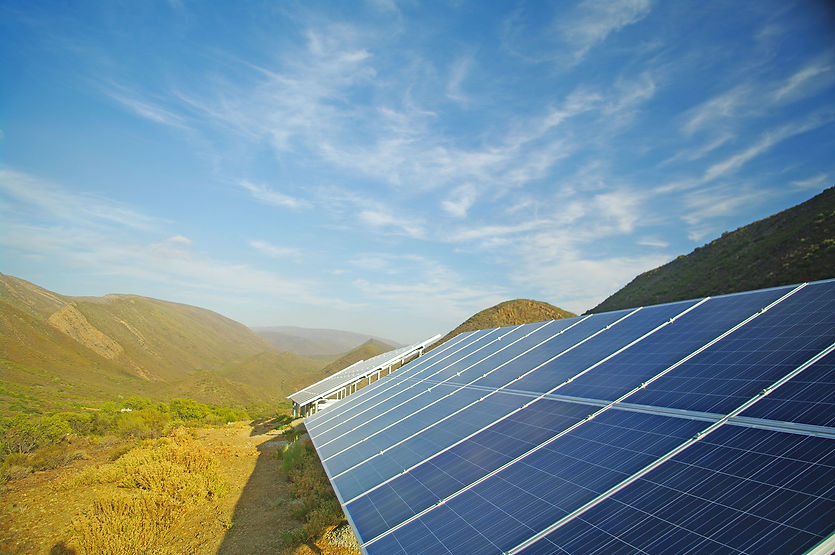
The farm is off-grid, powered mostly by by solar-energy.
-
A total of 31 kW photo voltaic panel arrays and accompanying 4 lithium ion battery bank (120 kWh capacity) with inverters and MPPT charge controllers, together with the turbine delivers the day to day electrical supply for the fish farm. For cloudy days the 16kW diesel powered generator may briefly assist.
-
The water pipeline allows for a pressure build-up of almost 7 bar, which in turn drives a micro hydro turbine. Thanks to this ‘high pressure, low water volume’ turbine we can generate up to 1 kilowatt of continuous electricity, which in turn assists our battery bank and takes over some of our electric load at night.
-
The 3 eco cottages have their own power supply of 4800W photo voltaic panel arrays and 24 2V gel batteries.

Energy Efficiency
-
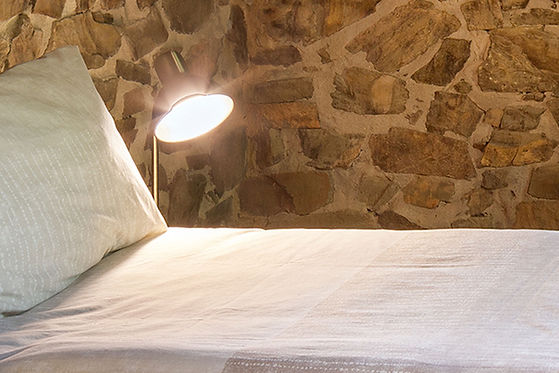
All units are equipped with energy efficient lights and appliances, as well as water savings fittings and fixtures.
-
The farm makes use of gas and solar geyser for all hot water use.
-
All lights on the farm are LED and energy efficient. The main farm buildings have remote sensor switches installed thereby reducing the need for copper cabling.
-
All appliances were and are continuously quality-checked to be as highly energy efficient as possible.
Net Zero
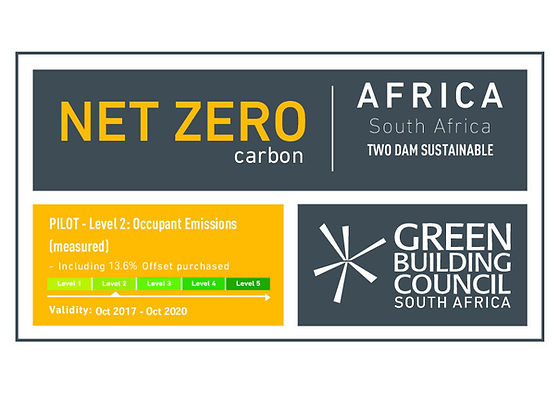
In October 2017, we received one of the first four Net Zero certifications in South Africa. The certification, awarded by the Green Building Council of South Africa, recognises projects that have taken the initiative to reach the endpoint of completely neutralising or positively redressing their carbon emissions; water consumption; solid waste to landfill and their negative ecological impacts. Two Dam Sustainable received the Net Zero certification in the carbon category, meaning the farm is carbon neutral.

Innovative Energy Project AEE
In 2019 we received an international award for Innovative Energy Project of the year for Sub-Saharan Africa Region from the Association of Energy Engineers.
Innovative Energy Project SAEE
In November 2018 we received a certificate from the Southern African Energy Efficiency Confederation for our contribution to the energy efficiency industry in Southern Africa for Innovative project of the year 2018.

Net Zero Innovative Project GBCSA
In October 2018 we won the Net Zero Innovative Project Award from the Green Building Council of South Africa.
Two Dam Sustainable, Langhoogte Pietersfontein, Montagu, 6720
33°38'19.1"S 19°58'37.2"E